Non-Destructive Structural Health Monitoring – Muridke Foundation Site
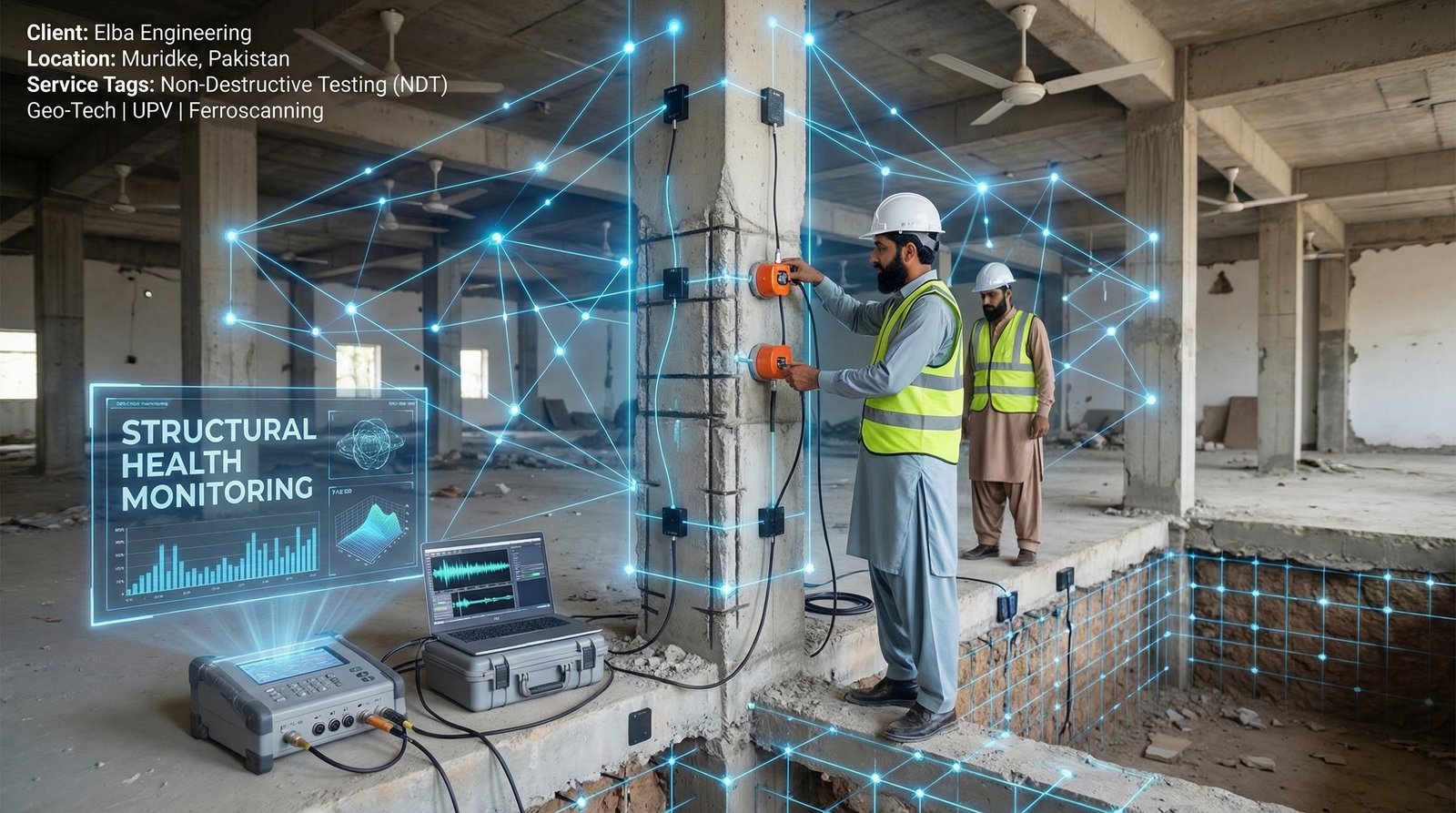
Executed Ultrasonic Pulse Velocity (UPV) testing and ferroscanning of shallow foundations for multiple structural columns to verify structural integrity without compromising the build.
The Challenge
The Non-Destructive Structural Health Monitoring – Muridke Foundation Site project, executed by Sentrum Engineering Services (SES), addressed three critical challenges: assessing existing integrity through evaluation of structural health of shallow foundations for multiple structural columns at a site in Muridke; achieving verification without damage by ensuring quality and strength assessment of concrete and internal reinforcement placement without physically compromising existing structural elements; and addressing subsurface uncertainty by providing high-precision data on internal concrete condition and structural "as-built" reality to ensure safety standards compliance.
Measurable Impact
Non-Invasive Verification
Successfully verified structural integrity and foundation quality without causing any damage to existing structural elements, preserving the building's operational status.
Informed Engineering Decisions
Provided comprehensive data on concrete quality and reinforcement placement, enabling precise engineering assessments and recommendations.
Risk Mitigation
Identified potential structural issues before they could become critical failures, ensuring long-term safety and stability of the foundation system.
The Solution & Outcome
SES utilized Ultrasonic Pulse Velocity (UPV) testing to assess the homogeneity and quality of the concrete. By measuring the speed of ultrasonic pulses through the foundation, the team could identify potential internal voids, cracks, or honeycombing that might compromise structural integrity.
High-tech ferroscanning was employed to non-invasively map the reinforcement bars within the concrete, allowing the team to verify rebar size, spacing, and concrete cover against original design specifications. The integration of these non-destructive methods provided a complete "health check" of the foundation columns, ensuring they were fit for their intended load-bearing purpose without compromising the existing structure.
Key Technologies Used
- Ultrasonic Pulse Velocity (UPV) testing for concrete quality assessment
- Advanced ferroscanning for reinforcement mapping and verification
- Non-destructive testing protocols for structural integrity evaluation
- Specialized analysis for internal concrete condition assessment